

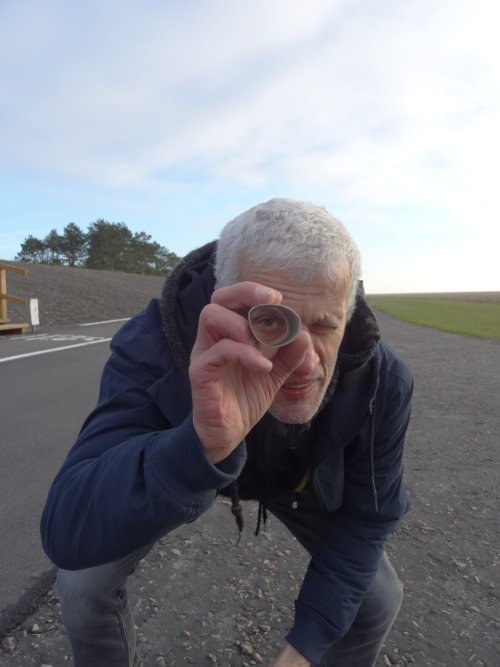
Why do we buy so much toilet paper in Germany for the Corona lockdowns?
I have found the answer to this question!
On 17 and 18 July 2021, I answered this question publicly and visibly for all at an art installation on Schlossplatz Oldenburg.
They collected toilet paper cardboard sleeves in advance or brought them past the two days.
1000 thanks to all of you. The NWZ also reported on 13.07.2021!
Art installation: What do I care about my legacies? I AM CLEAN!
Hunter’s fence, nickel-plated wire, TV armchair with footstool and ‘Deutscher Michel’ hat, cupboard, screen, 12,500 toilet paper cardboard cores
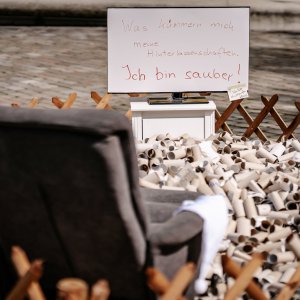
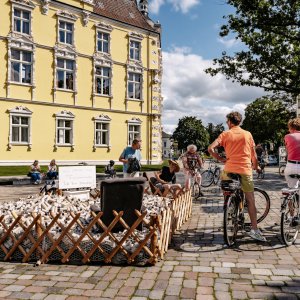
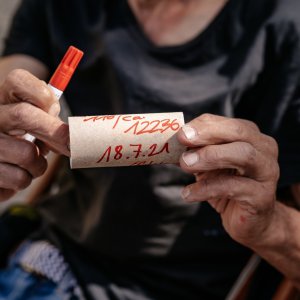
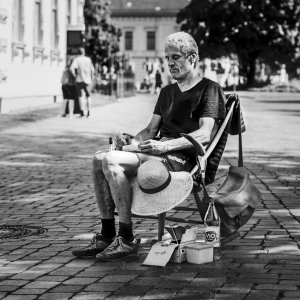
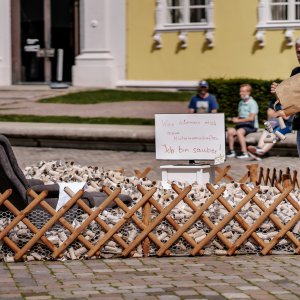
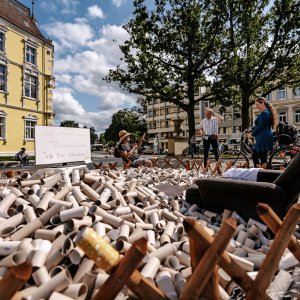
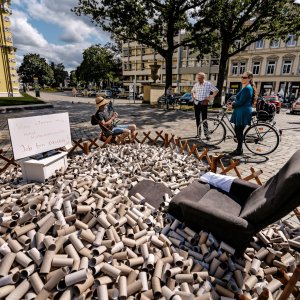
17 and 18.07.2021, Oldenburg Palace Square
-
Also available:


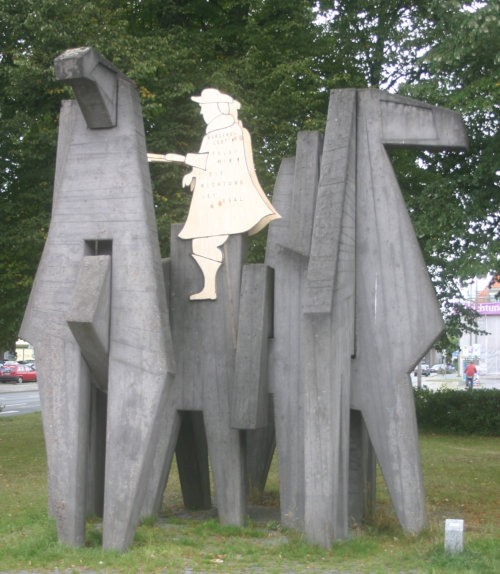
Installation for discussion summer 2011, in Oldenburg to put up a naturalistically designed bronze statue of Count Anton Günther on his horse ‘Kranich’.
Text on the wooden silhouette: “Citizens' Lieutenant! Follow me! The direction does not matter.”
-
Also available:
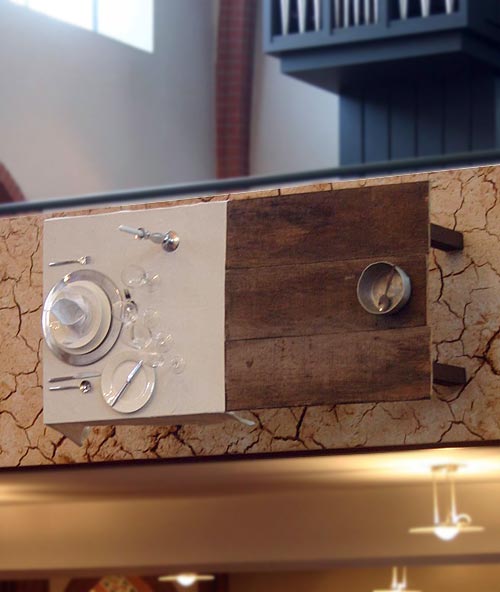
Installation for the German Evangelical Church Congress 2009 in the St. Ansagri-Kirchengemeinde Oldenburg
Esther Olsen-Velde and Michael Olsen
Material: Table, 150 cm x 75 cm x 70 cm (LxWxH), white/raw wood, tablecloth, crockery, cutlery, 1 x banner 600 cm x 95 cm
Topics: Food, food distribution, poverty versus wealth, abundance and hunger, "Where do I live?"
Description of installation:
The parapet of the choir pore, in the back of the church visitors, is placed by means of a printed banner.
These banners are designed with the view of a dried riverbed - dried, cracked, loamy soil (see photo).
A table is hung on = in front of the banner of the choir pore, so that the legs "stand" on the vertically hanging banner. This also makes the table top of the table transversely perpendicular. Visitors to the church can thus see the table top in its top view.
This table is designed in such a way that its left half is richly decorated with white tableware, silver cutlery, wine glasses and white tablecloth, the other half -raw, rough wood, brown, poor - without any table covering, on the other hand, with a slightly dented tin bowl as dinnerware and a slightly bent tin spoon stuck in this dining bowl. It is consciously just a table to represent that all people are sitting "at one table", living in a common world. The table is set without perishable food, it is set only for a meal.
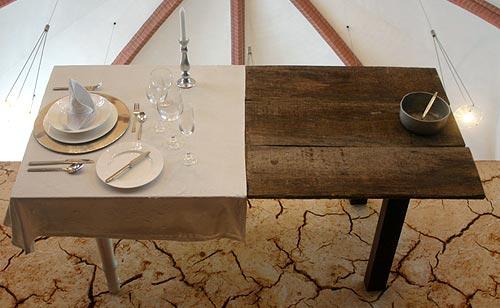 The tablecloth is plastinated by means of a special process. It is hard and stiff and falls from the tabletop to the legs, so whether the table is standing on the floor as usual. Dishes and cutlery are securely and invisibly attached.
The installation is mounted without any influence on the wooden panelled parapet. The installation is suspended from above over the edge of the parapet by means of specially made, invisible retaining clips. Any damage and danger is excluded.
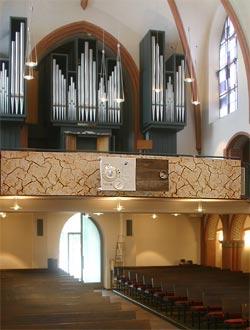 In the artistic language form of a spatial installation, this work refers to the distribution of food on the globe. Excess is juxtaposed with hunger.
The title of the work "Man, where are you?" addresses the visitor of the church with a question addressed directly to him and thus leads him to a self-given answer to this question: "Where am I?"
Conception: The installation "Man, where are you?" is a contribution to the topic of the different distribution of food in the world: Hunger versus abundance, luxury versus poverty.
This circumstance is to be visualized by the visitors of the church in an inviting and provocative way. The chairs next to the table should entice visitors to ask the question "Man, where are you?" to the autosuggestive answer "Where am I?", "Where am I sitting?".
However, the banner hung behind the table and chairs will give visitors a clear impression that all people live on the same livelihood and that it must be distributed fairly and for the good of all people.
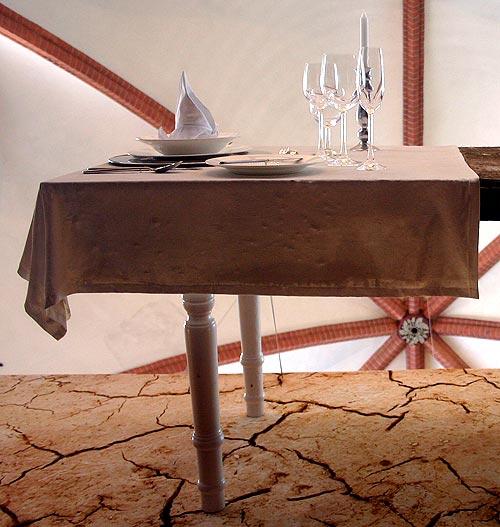 The depiction of the dried-up soil - the sign of lack of water and drought, drought, poverty - on the banners in front of the parapets conveys the danger to humanity: Lack of water affects all of us. Preserving creation means overcoming the current and spreading situation in the world with hunger and abundance, as well as poverty and wealth, in which the people of the rich nations and the people living in them must participate.
We would like to address the visitors with the title of the Kirchentag 2009 directly, let them decide for themselves where they stand, where they sit, whether the current state of the world is ethically justifiable.
It is part of the concept that the table and chairs are attached to the gallery armor of the choir gallery, i.e. in the back of the sitting worshippers.
The central part of the installation, the table and the two chairs, are only visible when going out of the church. The view of the installation is given to the visitors when they leave the church on the way "out", into everyday life.
And during the service, the mentioned problem lies in the back, it pushes us, it persecutes us, it lurks in the back, behind us all people.
Oldenburg, January 2009
-
Also available:
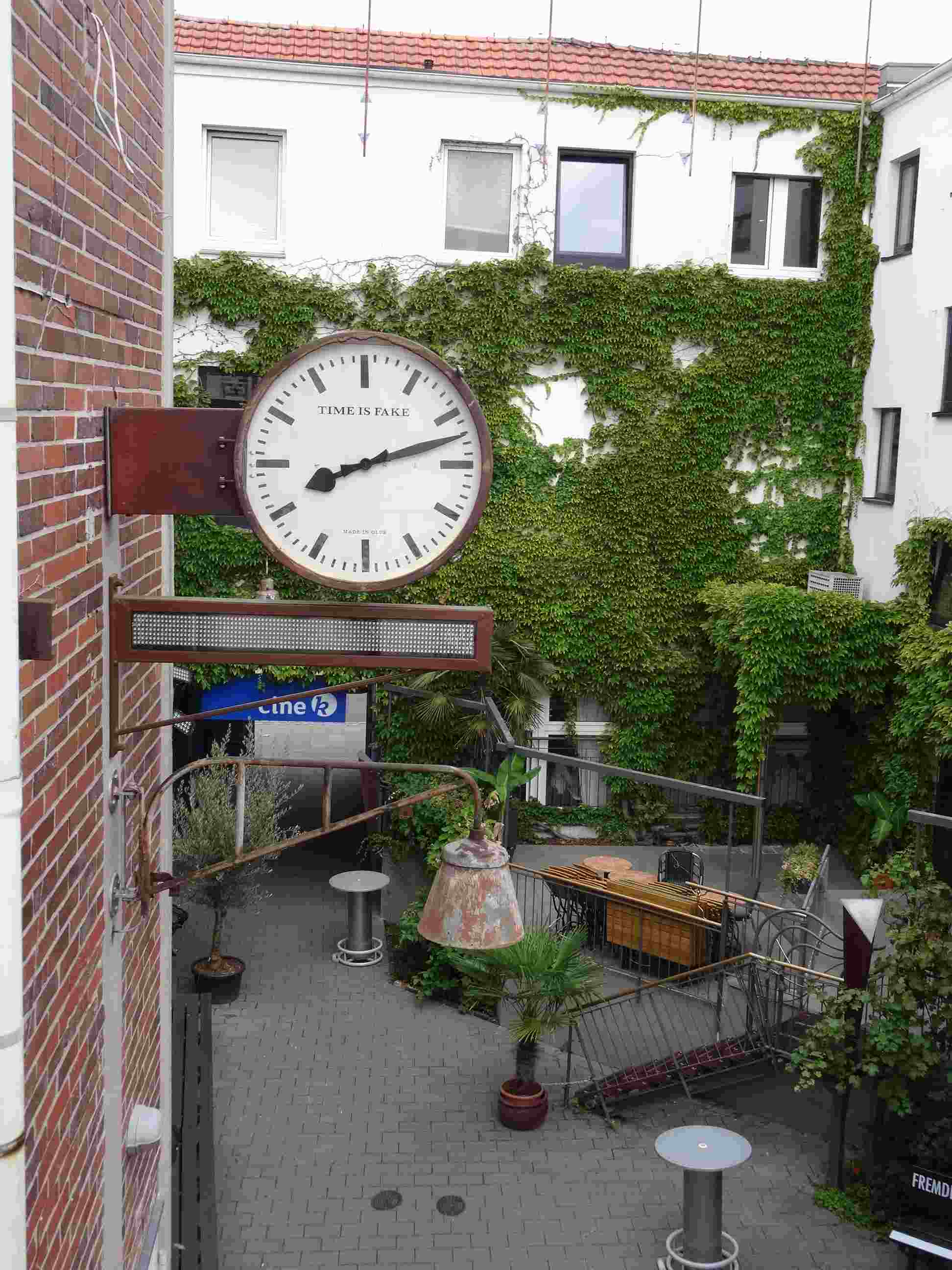
Time is Fake
An installation on the topic of ‘time’
Installation, 2017 - 2019
Cultural floor Oldenburg, inner courtyard
Industrial watch with two dials, 67 cm diameter, year of construction ca. 1958
Sculpture base 110 x 25 x 25 cm, white
Large-area handheld pushbuttons, sun yellow
Control electronics
‘Time is fake’ is a work of art by the Oldenburg artist and art technician Michael Olsen from 2016 – 2018, which was created in cooperation with experts in the hardware and software, programming, mechanical engineering and clock technology sectors. It is based on the idea of Michael Olsen and deals with the topic of ‘time’ and the question of whether there is time at all, whether it is really measurable, what it does to humanity and creation, how bypassing and ‘life after time’ affects us humans and how we deal with it.
The artistic idea behind the work ‘Time is Fake’ aims to counteract the constant urge to ‘forward, forward!’ triggered and supported by clocks with hands and to trigger a reflection process on the topic of ‘time’ among the viewers. And this in a confusing and at the same time humorous way.
The clock is a harlequin, a clown, it counters the idea that clocks always go forward. Time is revealed only when it is needed: For measuring time spans, specifying appointments, specifying data, events.
Otherwise, time does not exist, it is a human invention.
Nevertheless, today's world is inconceivable without clocks, it is now even impossible without clocks. And at all times of humanity, the time of day and season, perceived by the sun, temperatures and length of the day, has accompanied and determined people and all other living beings.
The influence of ‘time’ has been significant since the beginning of the ability to measure, determine and focus precisely on the development of life on the globe. The purpose of the work of art is therefore, on the one hand, to confuse and amuse the viewer and, at the same time, to offer a critical rethinking of ‘time’ and, at the same time, to offer a critical rethinking of ‘time’.
‘Time is Fake’ has its own game, its hands can move forwards and backwards, fast or slow and opposite to each other, in large and small increments. And this completely uncontrolled and free and to each other without reference. The movements are independently controlled by means of a computer-based random generator for each individual pointer. So this clock does not indicate local time, it ‘plays crazy’, it invites confusion, makes you wonder. Nevertheless, it is possible to query the current local time, i.e. to operate the clock and thus enable the local time to be displayed on the clock.
This is because the clock includes a sun-yellow large-area hand button (sun-yellow, because 12:00 o'clock = zenith of the sun = greatest brightness of the day = primal reference of humanity to ‘middle of the day’). Pressing this button causes the control to set the hands to the real local time Oldenburg for 7 seconds. After these 7 seconds, the clock starts again with its free play. Pressing the button allows you to pause for a short moment.
This installation ‘Time is Fake’ has its place in the courtyard of the Kulturetage, Oldenburg, a socio-cultural centre for a wide range of performing and visual arts founded 30 years ago.
On this intersite, which is to be visited worldwide, it is also possible to set the clock fastened in Oldenburg to a local time with a clickable button.
In the event, for example, that a visitor to the San Francisco homepage clicks on the button, the clock in Oldenburg adjusts to the local time in San Francisco and the origin ‘San Francicso, USA’ is also displayed on an LED display under the clock. The web camera transmits this image to the homepage, so the image of the clock can also be seen in San Francisco.
-
Also available:
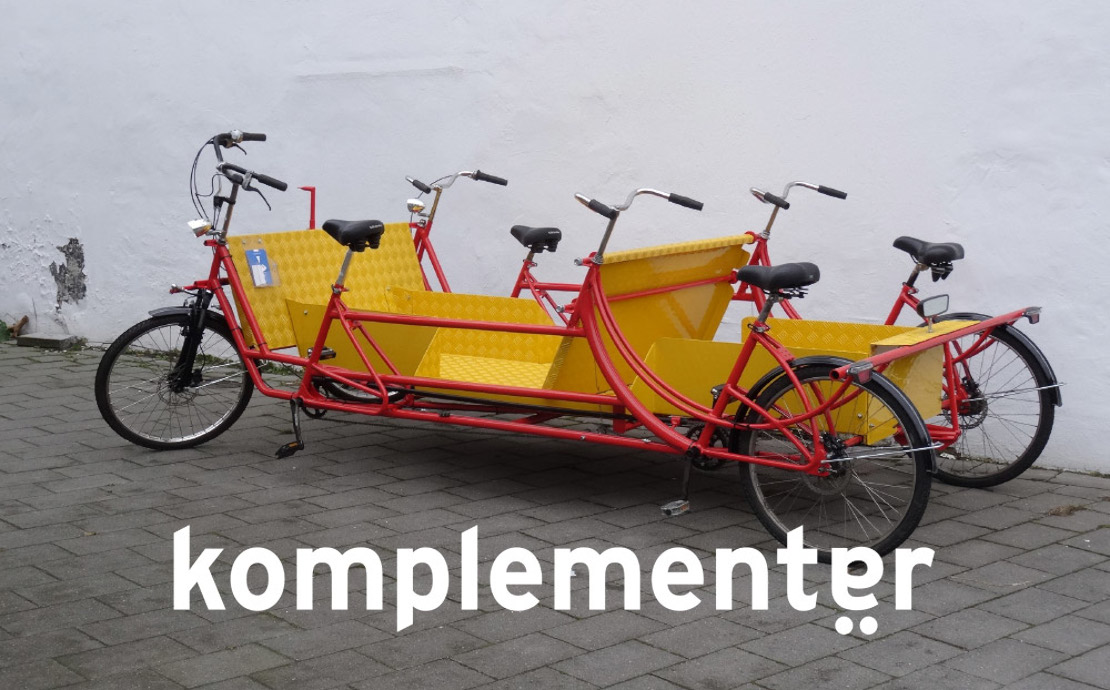
The power vehicle
a mobile installation for public space on the topic of "Road traffic in metropolitan areas and traffic collapse"
Steel pipe, aluminum sheet
Plastic, rubber, bicycle technology
200 x 120 x 390 cm
funded by the Cultural Fund of the City of Oldenburg in 2018
‘Complementary’ is a political work of art. ‘Political’, as it critically addresses the issue of ‘road traffic in metropolitan areas’.
It is a work of art in the form of an installation, in this case a mobile = mobile installation, which provides a novel and unusual impulse in the examination and discussion of the topics of traffic infarction, smog, bicycle versus car, etc.
‘complementary’ deals with the current developments of traffic infarction in agglomerations, exhaust emissions, space consumption, speed, road use and and and.
‘Complementary’ deliberately and deliberately transcends socialised patterns of thought and behaviour on the subject of ‘choice and use of a road transport vehicle’, thereby deliberately forcing an examination of the topic and at the same time generating a considerable amount of attention and humor.
‘Complementary’ means a motor vehicle, and therefore a vehicle that, unlike the cars incorrectly referred to as ‘motor vehicles’, is powered by force instead of fuel, with muscle power.
More information on road traffic law and the definition of "vehicle" in STVO and STVZO at www.kraft-fahrzeug.de
-
Also available:
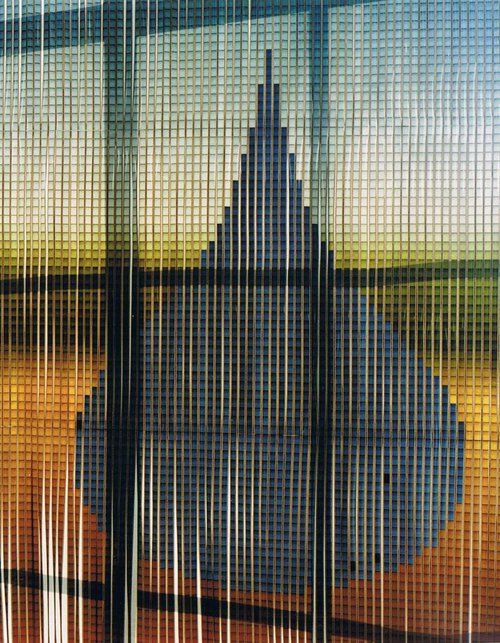
Installation in an employment office
Large area slide, curtain
450 x 250 cm
consisting of 210 slide films and 7560 individually taken photos of colored surfaces
1999
-
Also available:
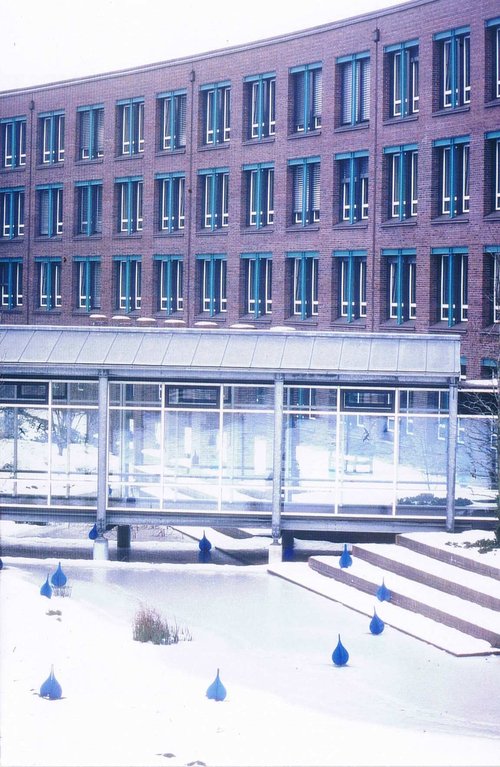
Installation in an employment office
100 drops of plexiglass
40 x 50 m
1999
-
Also available:
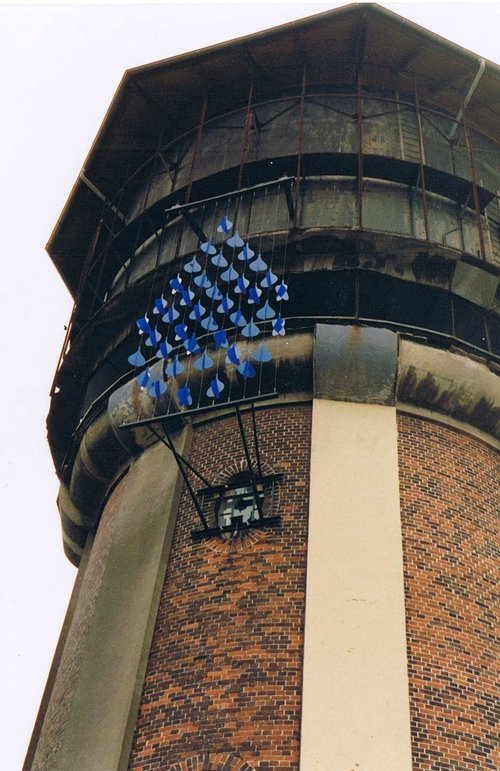
Water tower Stau 144, Oldenburg
Installation on two former Oldenburg water towers
1996
50 drops of plexiglass, 50 x 30 cm each
Wire ropes, hanging device
500 x 300 cm
The drops were produced with the kind support of the Töller Laserkraft company in Hagenburg.
-
Also available:
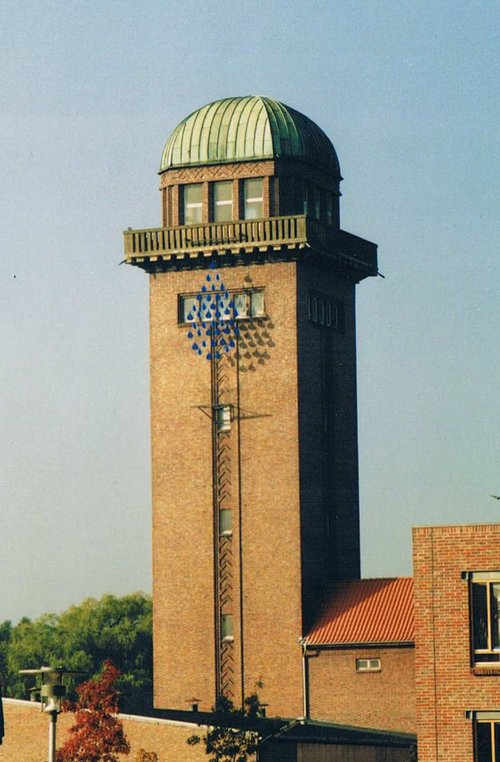
Water Tower Industrial Road Old FleiWa
Installation on two former Oldenburg water towers
1996
50 drops of plexiglass, 50 x 30 cm each
Wire ropes, hanging device
500 x 300 cm
The drops were produced with the kind support of the Töller Laserkraft company in Hagenburg.
-
Also available:
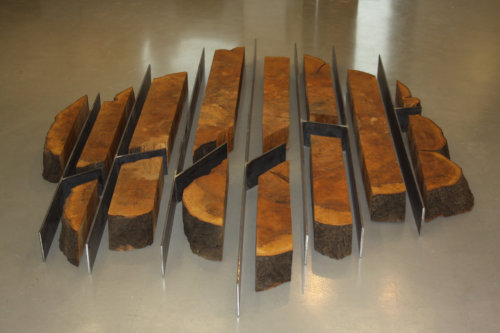
installation
lying on the floor
or wall mounting possible
Red beech 270 years, strip steel
200 x 260 x 15 cm
2011
-
Also available:
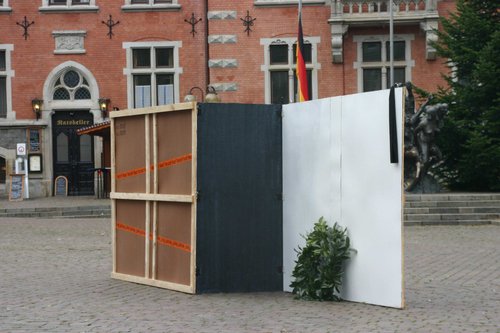
Esther Olsen-Velde and Michael Olsen
Be careful! Art?
Installation for Volkstrauertag 2007
HDF, Shawl, Funeral wreath, Bow
630 x 200 x 110 cm
2007
-
Also available:
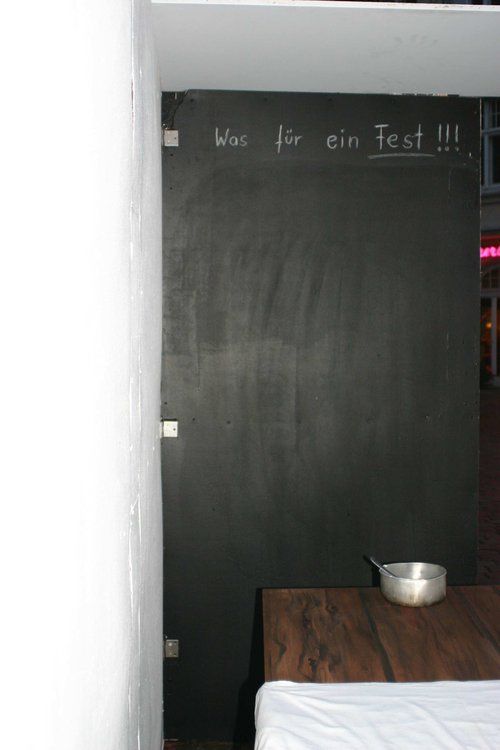
Esther Olsen-Velde and Michael Olsen
Be careful! Art?
Installation on Prosperity vs. Poverty and Christmas
HDF, Shawlwood, Table, Tablecloth, Silver and Porcelain Tableware, Bowl and Bones
‘What a party!!’ vs. ‘What a party?’
-
Also available:
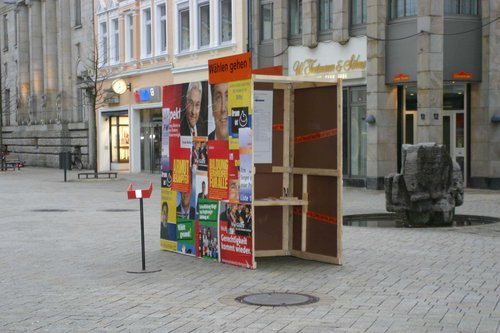
Esther Olsen-Velde and Michael Olsen
Be careful! Art?
Installation on ‘Go to vote’
HDF, Shawlwood, Voting posters, Ballots, Pen, Urn
320 x 200 x 110 cm
2008
-
Also available:
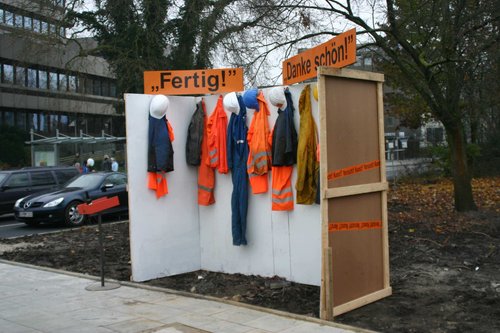
Esther Olsen-Velde and Michael Olsen
Be careful! Art?
Installation to complete a construction project for the conversion of a central traffic junction
‘Done!’ ‘Thank you very much’
HDF, Shawlwood, Workwear, Coat Hooks, Work Helmets
Thanks to the companies Gummi Stricker, Oldenburg and Ludwig Freytag, Oldenburg
320 x 220 x 110 cm
2008
-
Also available:
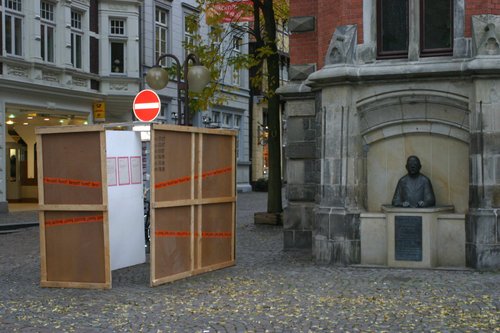
Esther Olsen-Velde and Michael Olsen
Be careful! Art?
Installation on the anniversary of the Reich Pogrom Night on 9 November and the date of 9 November in the history of Germany
HDF, Shawl, Text boards
320 x 220 x 110 cm, 9 November 2008
Texts on the boards
9 November 1848
Suppression of the democratic-bourgeois revolution by the execution of the Republican MP Robert Blum
9 November 1911
August Bebel, leader of the Social Democratic Party, gives a prophetic speech in the German Reichstag and sees the danger of war (the 1. World War I): ‘Then comes the catastrophe. Then the great general march is defeated in Europe, on which 16 to 18 million men, the men's flower of the various nations, equipped with the best murder tools against each other, come into the field as enemies. But I am convinced that behind the great general march is the great Kladderadatsch. Behind this war stands the mass bankruptcy, the mass misery, the mass unemployment, the great famine. (...). You have been warned.”
9 November 1913
The one-day general meeting of the Association of German Jews in Hamburg, attended by 2000 participants, points to the disregard for constitutional principles in the treatment of Jews in the German Reich and calls for equal rights for all citizens in view of the growing racism.
9 November 1913
On Fort Spitsberg (fortress Silberberg) near Wroclaw (today Wroclaw) a recreation home for the paramilitary, semi-state youth organization Jungdeutschlandbund, donated by the German Emperor Wilhelm II, is inaugurated.
9 November 1918
In Berlin, from the Reichstag, the German Republic is proclaimed by the Social Democrat Philipp Scheidemann.
9 November 1918
Karl Liebknecht proclaims the soviet republic in Berlin in front of the royal palace.
9 November 1918
William II declared his abdication as German Emperor, but not as King of Prussia.
9 November 1923
‘March to the Feldherrnhalle’ (Hitler putsch)
9 November 1923
In response to the Hitler coup (8./9. 11.) the Bavarian Commissioner General Gustav Ritter von Kahr orders the immediate dissolution and prohibition of the NSDAP and the right-wing radical associations Oberland and Reichsflagge. On the 11th On 9 November, this measure will be extended to the KPD of Bavaria. All social democratic and communist newspapers and magazines are also banned.
9 November 1923
The French ambassador François Marie Pierre de Margerie will present himself to Chancellor Gustav Stresemann to address the concerns of his government about the Hitler coup (8th/9th century). 11.) and the danger of a legal dictatorship in the German Reich.
9 November 1925
Establishment of the terrorist organisation "SS" (Schutzstaffel), elite organisation of the NSDAP. It was established as a party police force. In 1929 Heinrich Himmler took over the leadership of the 280-strong troupe and created from it a men's order with black uniforms, skull symbolism and strict selection criteria. The SS became the most important state protection force of the Nazis, its name is inextricably linked to the worst crimes of the fascists. H. Himmler’s motto ‘I do not have to practice justice, but to destroy and exterminate’ (March 4, 33) was ruthlessly implemented by the SS during the twelve years of terror rule.
9 November 1930
In the municipal elections in Oldenburg, the NSDAP became the strongest party. It can increase the number of its seats in the city parliament from one to 18 seats.
9 November 1938
The ‘Reich Crystal Night’ organised by SA men killed over a thousand Jews.
November 8 to November 9, 1939
A bomb attack on Adolf Hitler by Georg Elser in Munich's Bürgerbräukeller fails. Georg Elser: “I wanted to prevent the war.”
9 November 1939
In the Buchenwald concentration camp near Weimar, 21 Austrian and German Jews are shot after the news of the attack on Führer and Reich Chancellor Adolf Hitler arrives.
9 November 1949
In the GDR, former members of the NSDAP, provided they were not classified as activists or convicted of war crimes, as well as former officers of the German Reichswehr, receive all civil rights again.
9 November 1967
Shielded by a huge contingent of police, the first hearing on the questions of emergency legislation begins in Bonn. A banner reads: ‘Unter den Talaren Muff von 1000 Jahre’ (Under the Talaren Muff of 1000 Years). The students protested against what they saw as a lack of reappraisal of the crimes of the so-called ‘Third Reich’ in post-war West German society, as well as against elitist structures and obsolete traditional lines of university politics. They demanded their democratization and the co-determination of the student body.
9 November 1974
In the Wittlich prison, the alleged ‘RAF’ member Holger Meins dies as a result of a hunger strike.
9 November 1974
In Mülheim an der Ruhr, the ‘Deutsche Soziale Union’ (German Social Union) is founded as a federal party. Vice-Chair Helmut Kasper stated that the party "wanted to stand unbreakably behind the admired ... and recognized Dr. Franz Josef Strauss for a new national reliability".
9 November 1983
The Catholic Bishops of France at their Plenary Assembly in Lourdes approved nuclear deterrence as a means of preventing war.
9 November 1989
The GDR opens the borders to the Federal Republic of Germany and West Berlin.
9 November 1990
Chancellor Helmut Kohl and Soviet President Mikhail Gorbachev sign the ‘Treaty on Good Neighbourhood, Partnership and Cooperation’ in Bonn. They agree on close political and economic cooperation between the two countries.
9 November 1998
Berlin: At the central event for the 60th anniversary of the pogroms against the Jews in Germany on 9 November 1938, Federal President Roman Herzog described the pogroms as one of the worst and most shameful moments in German history.
9 November 1999
In the presence of George Bush and Mikhail Gorbachev, the German Bundestag is celebrating the tenth anniversary of the fall of the Berlin Wall.
9 November 2001
Dresden: 63 years after the destruction of the old Jewish church, a new synagogue is consecrated.
9 November 2003
In the presence of Federal President Johannes Rau, the foundation stone is laid for the new Munich Synagogue and the Jewish Center.
9 November 2004
Across Germany, the opening of the Berlin Wall in 1989 is commemorated, which initiated the rapid end of the GDR on 9 November 1989.
9 November 2006
68 years after its destruction, the new main synagogue is ceremoniously opened in Munich.
9 November 2008
Commemoration of the Reich Pogrom Night: On the 70th anniversary of the pogrom night of 9 November 1938, German Chancellor Angela Merkel (CDU) warns against indifference to racism and anti-Semitism at the central commemorative event in Berlin's Rykestraße synagogue. Germany needs a climate that promotes civil courage.
9 November
A holiday or a day of remembrance?
-
Also available:
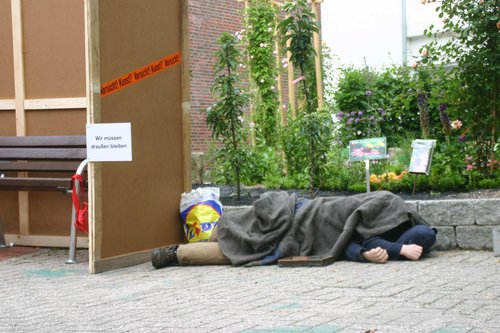
Esther Olsen-Velde and Michael Olsen
Be careful! Art?
Installation on the topic of homelessness
HDF, shawl, bench, doll, plastic bags, text board ́We must not enter here! ́
500 x 220 x 110 cm
2010
-
Also available:
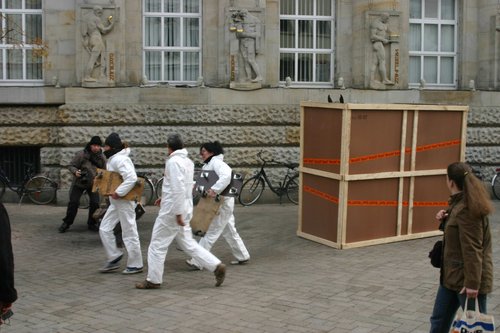
Esther Olsen-Velde and Michael Olsen
Be careful! Art?
Concealment of a naturalistically designed bronze statue
Donnerhall
2007
HDF, Shallowwood, Hinges
320 x 200 x 110 cm
-
Also available: